
- Online only
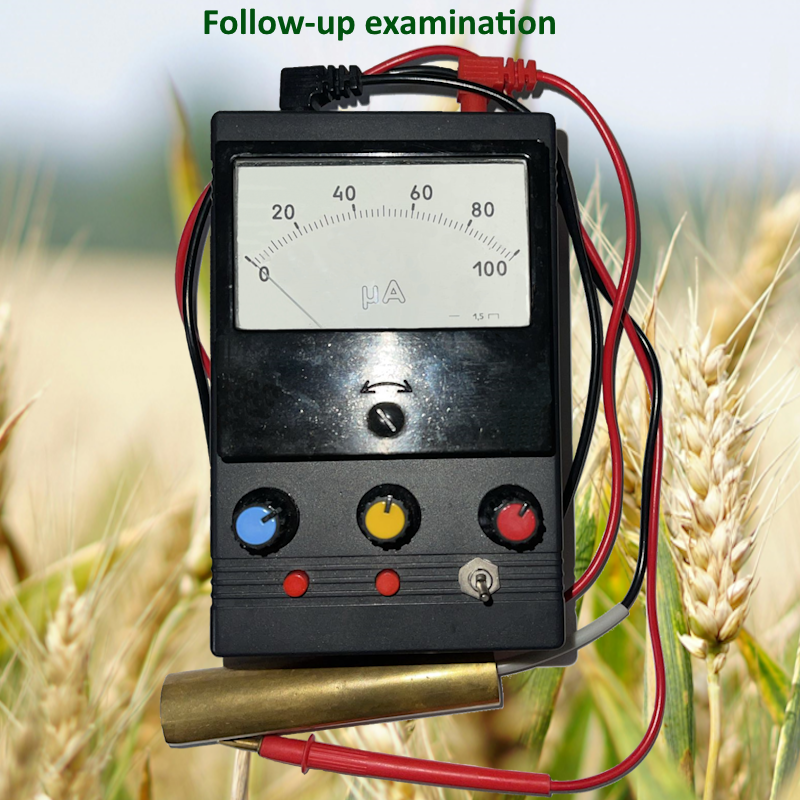

Follow up E.V.A.
The examination takes approximately an hour.

Security policy

Delivery policy

Return policy
Below is a clear, complete, and neutral explanation of how the Voll method (EAV – Electroacupuncture according to Voll) is claimed to work and how an operator uses the device, without endorsing its medical effectiveness.
A Voll device is used in Electroacupuncture according to Voll (EAV), an alternative diagnostic method developed in the 1950s by Dr. Reinhold Voll, a German physician.
The device is essentially a low-voltage electrical resistance meter. It measures electrical skin conductance at specific points on the body that are believed (in EAV theory) to correspond to acupuncture meridians and internal organs.
Hand electrode (reference electrode)
Held by the patient, usually a metal cylinder
Completes the electrical circuit
Probe electrode (measuring stylus)
Held by the operator
Applied to acupuncture points on the hands or feet
Measurement unit
Displays readings (often 0–100 scale or digital values)
May include analog needles or digital screens
Optional test substance tray (on some models)
Holds vials, substances, or filters claimed to influence readings
The device sends a very small electrical current (typically microamps) through the skin.
It measures electrical resistance or conductance at the point touched by the probe.
Skin moisture, pressure, temperature, and contact quality all affect readings.
According to Voll theory:
Specific acupuncture points are linked to:
Organs (liver, kidneys, lungs, etc.)
Body systems (nervous, endocrine, immune)
Changes in electrical resistance at these points are believed to reflect imbalance or dysfunction.
Typical interpretation used by operators:
| Reading range | meaning |
|---|---|
| ~50-70 (mid-range) | “Balanced” or normal |
| High (70–100) | “Inflammation”, stress, overactivity |
| Low (0–50) | “Degeneration”, weakness |
| Needle drop | “infected condition” |
Patient removes metal jewelry
Hands and feet are cleaned and dried
Patient holds the reference electrode
Operator presses the probe onto specific acupuncture points
Pressure must be consistent (this is critical)
Readings appear on the display
Operator watches:
Peak value
Stability of reading
Whether the value “drops” after reaching a peak
Some operators:
Place substances (homeopathic remedies, supplements, allergens) into the device circuit
Re-measure the same point
Observe whether readings change
This is claimed to indicate “compatibility” or “resonance,” though this has no scientific validation.
Based on readings, the operator may:
Identify “imbalanced meridians”
Recommend supplements, homeopathy, acupuncture, or lifestyle changes
From a scientific standpoint, the device measures:
Skin electrical resistance
Influenced by:
Sweat gland activity
Skin hydration
Pressure of the probe
Temperature
Operator technique
It does not directly measure:
Organ function
Disease
Infection
Toxins
Allergies
In short:
The Voll device measures electrical skin resistance at acupuncture points
The operator interprets these readings using acupuncture and meridian theory
The method is considered an alternative and non-diagnostic by mainstream medicine
Follow up E.V.A.
The examination takes approximately an hour.